Surveys miss the reasoning
Multiple-choice input rarely captures why residents support or oppose a policy. Staff end up with a result, but not the public reasoning behind it.
A yes or no result is not enough when the policy tradeoffs are complex.
ForoCivic gives towns and cities one place to frame an issue, host public deliberation, and brief staff from the public record that follows.
Traditional engagement tools produce fragmented input that staff cannot interpret confidently. The problem is not collecting more comments. It is building clearer civic understanding.
Multiple-choice input rarely captures why residents support or oppose a policy. Staff end up with a result, but not the public reasoning behind it.
A yes or no result is not enough when the policy tradeoffs are complex.
Public meetings are still useful, but they favor the loudest participants and leave leaders guessing whether the room reflects the broader community.
A small live audience rarely represents the full civic picture.
Comments spread quickly online, but they are hard to organize into a defensible policy read. Leaders need structure, not outrage volume.
Reaction volume does not tell staff what the public actually means.
ForoCivic is designed around the real municipal sequence: frame the issue, deliberate in public, preserve the record, and brief staff with something they can actually use.
A city or department opens one structured civic issue with clear context and scope.
Residents deliberate in a readable format where arguments and replies stay connected.
The analysis layer organizes themes, participation quality, and balance into a legible public record.
Staff receive a clear issue briefing with representation notes, risks, and recommended next steps.
A municipality starts a pilot and identifies the first issue it needs to open clearly.
ForoCivic configures the municipal forum, access mode, and resident verification rules for the town.
Staff create the first issue, generate invites, and decide whether public access is open, request-based, or invite-only.
Residents join, deliberate, and generate the first staff briefing once the issue has enough participation.
These screenshots were taken from the current interface so the landing page shows the real product, not a decorative mockup.
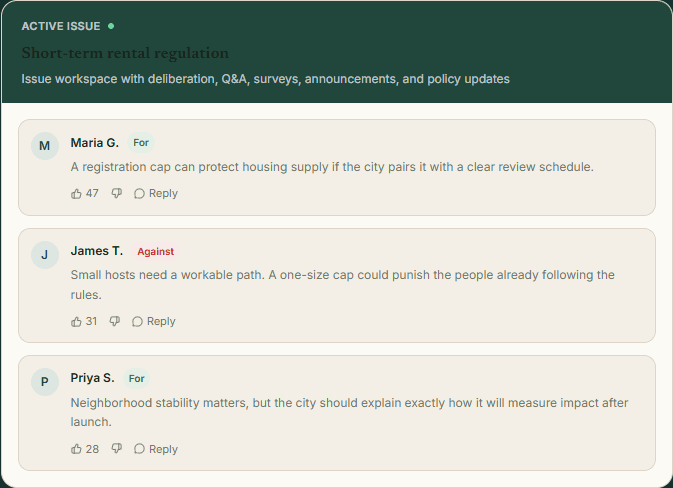
Issue forum
Current product screenshot of the issue forum and live discussion record.

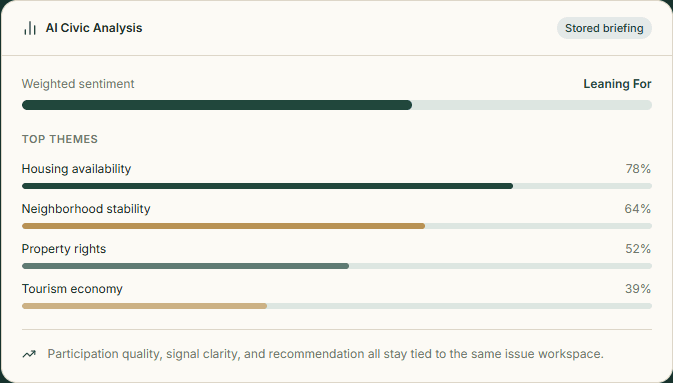
Analysis
Current product screenshot of the analysis view and staff briefing panel.

Residents discuss one issue in a structured forum with replies, reactions, and clear viewpoint labels.
Staff review the weighted read, top themes, and participation quality without leaving the issue record.
The decision trail keeps analysis, updates, and follow-through attached to the same issue.
ForoCivic turns issue discussion into a structured public read using the real issue record: arguments, replies, votes, questions, surveys, announcements, and policy updates.
Groups similar arguments so staff can see the shape of public reasoning instead of reading the same point repeatedly.
Surfaces the strongest recurring topics, concerns, and tradeoffs across the issue discussion.
Shows the current analysis after factoring in breadth, coherence, intensity, and confidence.
Shows whether the conversation reflects broad participation or a narrow, concentrated slice of the public.
Generates a structured issue briefing with signal quality, standout patterns, and next steps for staff.
Current analysis read
Participation growth
Activity increased after the issue briefing opened, then accelerated again when follow-up discussion began.
Theme concentration
If the city regulates, it should explain how it will measure whether more units return to long-term housing.
That is the right standard. Any new cap should come with a public review after the first year.
Small hosts need a workable path. Broad restrictions could punish residents who already follow the rules.
A licensing threshold could protect responsible operators while still addressing concentrated neighborhood impacts.
Residents are less worried about one home than the cumulative effect when an area turns over too quickly.
That suggests the rules may need to vary by district rather than treating the whole city the same way.
The ForoCivic issue model is built on a simple premise: public reasoning becomes more useful when residents respond to each other in a structured, readable environment.
Structured pro and con discussion keeps arguments grounded.
Threaded replies keep disagreement attached to a specific claim.
Questions, surveys, announcements, and policy updates stay tied to the same issue.
The AI layer reads the real issue record instead of working from disconnected fragments.
ForoCivic is designed to make civic process easier to explain, easier to review, and easier to carry forward from public input to final policy movement.
Role-aware access, modern authentication, and secure-by-default browser protections are part of the product baseline.
Issue updates, questions, analysis, and policy movement stay attached to one readable issue record instead of being scattered across tools.
The platform is built on authenticated municipal forums with row-level access control and organization-scoped data boundaries.
From deliberation to briefing to records, staff can preserve an institutional trail that is easier to audit and explain later.
Operational foundations already in the product
Pilot handoff
The platform is designed to make issue intake, citizen deliberation, structured analysis, and policy follow-through easier than spreading that work across separate tools.
What happens next